
Service-as-a-Software
How to build agentic software that sells.

"The rise of AI is another hype cycle."
False.
Having personalized intelligence assist you 24/7 couldn't be further from "just hype".
It's the means by which *we empower every individual to operate at a broader scale of skill & knowledge than ever before.*
Further, the rise of *artificial intelligence agents* will dwarf the economic impact of the microprocessor. And will be on par with revolution of commoditized electricity:
"Let there be light."
I know what you're thinking... in this world of vague tech memes, what *really* is an "AI Agent" ?
Well let me explain:
The Rise of AI Agents
AI agents are software that's enabled by non-biological decision making.
In other words an AI agent has the capacity to act on its own -- it can operate in a dynamic environment without the need for human judgment or intervention.
It has agency:
agency (verb): capacity to make autonomous decisions and act upon them to influence its environment & circumstance.
An assistant that can read your email inbox, access your knowledge base & calendar, & respond effectively is an agent. If they're a human we call them an executive assistant, if it's a software system we call it an AI agent.

The economic impact of the rise of AI agents as non-human operators will transform the world as we know it.
Some businesses will take on new verticals they'd never considered as the cost of exploring previously unthinkable avenues decreases. (expansion)
Others will replace human capital with increasingly productive software capital. (substitution)
And don't even get me started on when things get physical via robots...
The economy will be unrecognizable when we come out on the other side of the intelligence revolution.
Whether this transition is good or bad is debatable - my guess is it'll be a bit of both. What we do know for certain is that it is inevitable.
A New Gold Rush
As software development is made cheaper by AI, the biggest challenge for software businesses is not developing the product, it's distributing it to clients willing to pay for it.
So, how to best start selling?
In this piece, I will lay out a framework for how to build agentic software that is guaranteed to sell from day one. I call it Service-as-a-Software.
Here's how it works:
Service First, Software Second
There are millions, if not billions, of service businesses in the world. Every single one of them is a service provider fulfilling on an offer that relieves a client's pain point in a done-for-you (DFY) offer in exchange for money.
The Service-as-a-Software approach seeks to target one such offering as its niche in order to slowly automate the human operator out of the equation.
The end goal is a state where the entire service can be provided in do-it-yourself (DIY) fashion to the client (i.e. your team never needs to intervene).
The difference to the traditional approach of VC backed subscription software development (also know as Software-as-a-Service/SaaS)?
There is no risk to spend millions of dollars on building something people don't want. In the end, you've been selling the DFY service offer from day 1, no?
There's always been a need for a solution to the problem your software is addressing.
The 9 Steps to Service-as-a-Software
So, what are the steps to building Service-as-a-Software business?
Identify a service offer that is proximally fulfillable with the state of current agentic technology. (e.g. today: legal document drafting).
Learn the trade &/or build a team that allows you to fulfill the service in a done-for-you fashion. (e.g. find a lawyer to team up with).
Get a client willing to pay you for the service offer. (e.g. a boutique law shop in need to outsource document drafting).
Fulfill the service & document every step of the process into service provision flowchart.
Identify the core value adding activity of the offer.
Prioritize automating the core value add activity first.
Once rigorous quality standards are consistently met, work your way up & down the flowchart, automating everything between input and output of the service pipeline. (Ensure performance standards at every step before you move on.)
Package the full automated service pipeline as a traditional subscription software platform.
Scale to meet any demand by leveraging the beautiful economies of scale enabled by digital technology.
In Other Words: DFY -> Hybrid -> DIY
Get started with a DFY service offer. This means, you'll basically set up a traditional service business. At this point service delivery will take up the largest chunk of resources (i.e. time/money).
That said, you'll be looking into how to automate parts of the service pipeline from day 1 -- a first step towards DIY.
After spending some time as a hybrid between DFY and DIY, you'll have fully codified the service into software that can perfectly be packaged as a traditional subscription software.
At this point you'll have built a cashflow machine that can scale indefinitely, & meet the demand generated by sales & marketing.
Does it work?
I applied this approach myself while developing the X reply tool Apex. I first offered the reply guy service as a done-for-you service where people would fill out a google form and I would copy-paste everything myself on the backend.
This obviously didn't scale... so once I developed the reply agent (i.e. the main value add) I built an interface that seamlessly allowed client data to be modified and read by the system without my intervention. Huge resource saving endeavor that allowed me to focus on the next part of the service delivery pipeline.
Today the entire service delivery flow is pretty much automated - meaning that I can serve new clients without ever having to intervene myself.
Benefits of the Service to Software Model
The big benefits are twofold:
Iteration Speed
By going from service to software your product will have the most important development signal from day 1.
Revenue? Close... awesome to have (, & you'll have it too), but not what I mean.
It's client feedback.
You'll have 2 sources of feedback from day 1:
The first is your own team that's fulfilling the service. In the end your squad & you are trying to fulfill the service using the new software. You can't ask for a quicker feedback cycle.
The second is the client that is trusting you to fulfill the service! They will let you know if you're not meeting the bar with their words, actions & spending. All of which are feedback signals.
And in software - the product that iterates quickest on feedback - wins.
Economies of Automation
The second benefit working in your favor is that you'll have the two economies of increased automation working in your favor.
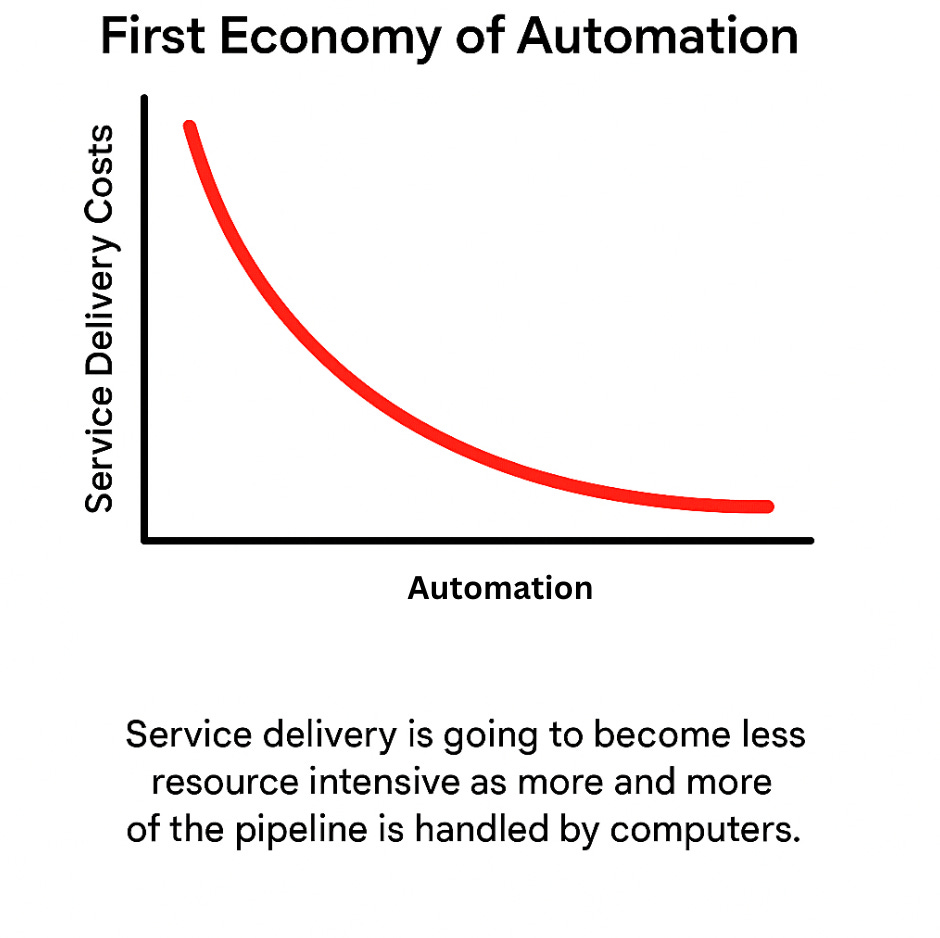
First Economy of Automation
Service delivery is going to become less resource intensive as more and more of the pipeline is handled by computers. This will reduce your costs
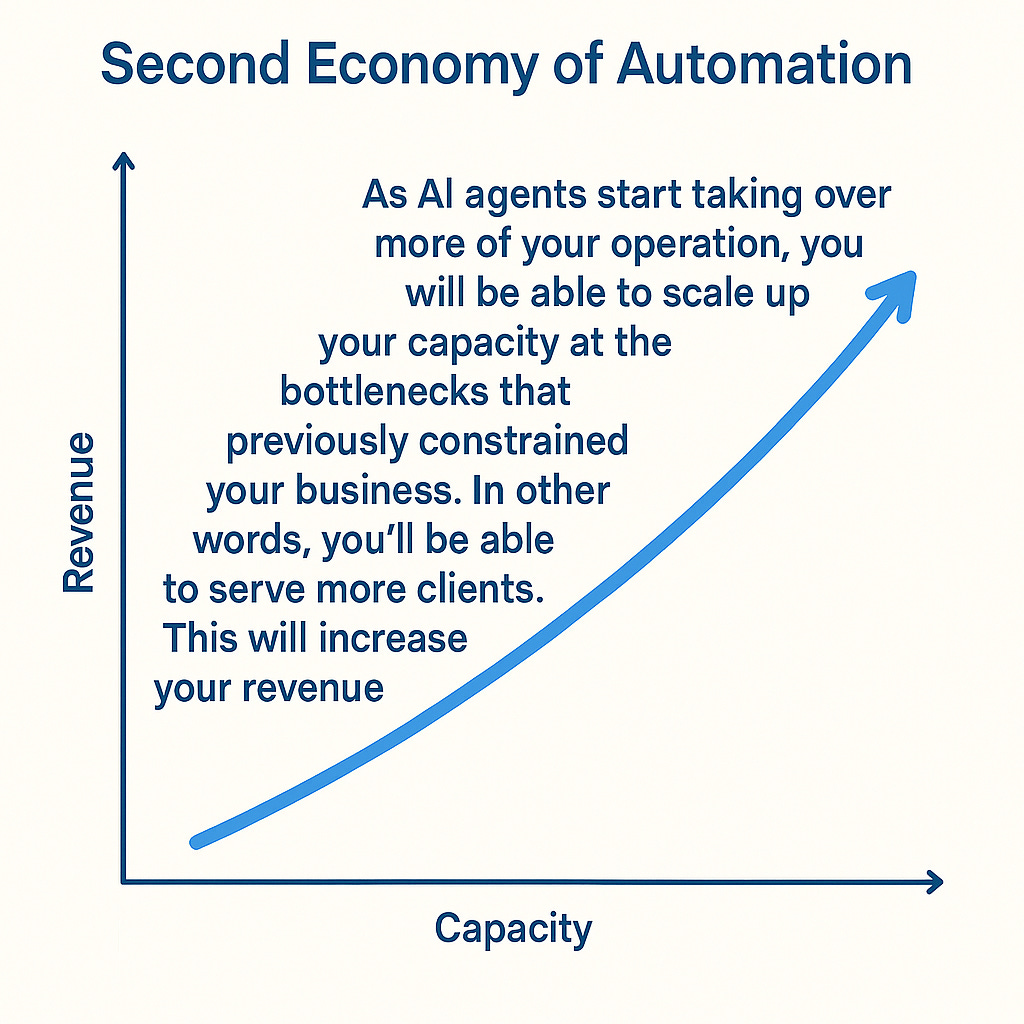
Second Economy of Automation
As AI agents start taking over more of your operation, you will be able to scale up your capacity at the bottlenecks that previously constrained your business. In other words, you'll be able to serve more clients. This will increase your revenue.
The Golden Age of Agentic Subscription Software
For most technologists the difficulty in building a software business is not in developing the necessary tech. It's executing on a business model that allows them to build a sustainable venture.
In the past, the capital intensive venture of building a software company required millions of dollars in VC funding. With AI development augmenting developer productivity to reach new heights, these costs are going to zero.
Building a software business today is the least resource intensive it has ever been, allowing ventures to go after niches with smaller total addressable markets (i.e. markets smaller than $100B) that used to be out of question when operating under the economic constraints needed to make the traditional VC model work.
For this reason we are living in the golden age of niche software, & why targeted AI agent subscription platforms are the next frontier to be conquered.
Once the ball gets moving in a niche, there is no reason why it should ever stop compounding.
Time to get the ball rolling my friend!